
Example: a fully completed submission
This page shows what a complete, high-quality submission looks like, using a well-known American dark-humor meme. Your answers do not need to be long — clear and specific beats long. The green notes explain why each answer is a good one; they are not part of the form.
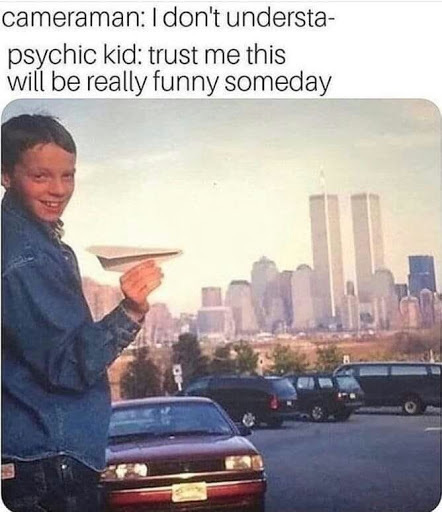
Step 2 — Provenance
| Where did you find this meme? | Public URL — https://www.reddit.com/r/dankmemes/
The link is optional: paste it if you have one. If the meme came from a private chat, pick “Private message” and leave the link empty. |
|---|---|
| When did you first see it? (year) | 2019
A rough year is fine; pick “Unsure” if you honestly don't remember. |
| Meme's culture/country of origin | United States |
| Meme's primary language | English |
| Culturally native? | Yes
This meme was created inside US internet culture — it is not a translated version of a meme from somewhere else. |
Step 3 — The questions
| Meme explanation (English) | The photo shows a smiling boy holding a paper airplane, with the
Twin Towers of the World Trade Center still standing behind him. The
caption presents him as a “psychic kid” who knows the September 11,
2001 attacks are coming and finds them funny. The joke works by
putting an innocent childhood photo next to one of the worst
national tragedies in US history.
Explain the meme as if to a foreigner who has never seen it: what it shows, what it refers to, and what it means. |
|---|---|
| Meme explanation (your language) | — (optional — this contributor's language is English, so it was left empty) |
| Emotion shown in the meme | Happiness
The boy is smiling — pick the ONE emotion that is mainly visible in the image/text. This is your own reading; other annotators of the same meme may answer differently. |
| Emotion the meme is meant to cause | Disgust
Choose the single strongest intended reaction. This dark joke aims to shock; “Sadness” would also be a defensible answer. |
| Purpose | Humor / entertainment · Mockery / ridicule |
| Target community | The victims of the September 11 attacks and their families — and
more broadly Americans, especially New Yorkers, for whom the attacks
are a national trauma. The meme makes them the subject of the joke.
This asks who the meme is ABOUT or attacks (the target community) — not who shares and laughs at it. |
| Under the norms of its culture, this meme is: | Toxic
It makes nearly 3,000 deaths the punchline. Under US norms, joking about the 9/11 victims is clearly offensive, even though the meme circulates widely as “dark humor”. Answering “Borderline” or “Toxic” opens the two follow-up questions below; they stay hidden for harmless memes. |
| Why it is toxic | It treats a mass-casualty terrorist attack as comedy. Nearly
3,000 people were killed on September 11, 2001, and the meme jokes
that this will be “really funny someday”. That trivializes the
victims and is offensive to many Americans — especially New Yorkers,
survivors, and victims' families.
Say WHAT is offensive, WHY it is offensive in that culture, and WHO is hurt by it. |
| Kind of toxicity | Abusive / insulting · Other |
| Would a platform moderator flag it? | Unsure
“Unsure” is a legitimate answer — don't guess. |
| Could it be illegal in its country of origin? | No |
| Who can understand it? | 1 — needs regional pop culture
The 9/11 attacks and the Twin Towers are known far beyond the US, but a viewer still needs that historical knowledge to get the joke. |
| Elements locking it to the culture | Event · Place / geography |
| Background facts (one per line) |
|
| Anything else researchers should know | The meme resurfaces every year around September 11; countless variations exist with the same photo and different captions. |